Sunday, January 20, 2008

Attepted Ranking of Outfield Arms

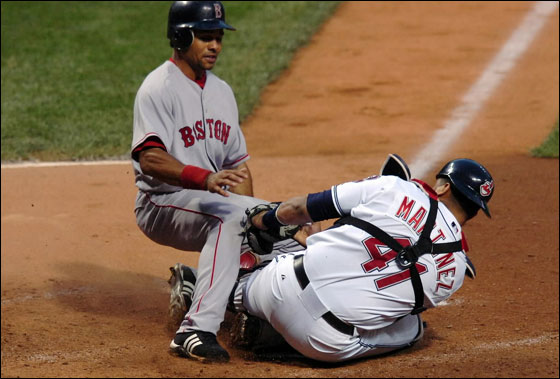
(Reuters Photo)

The Hardball Times attempted to rank the best outfield arms of 2007. This is the third year that they've attempted to measure outfield arms with their own sabermetric formula. John Walsh who created the system to measure outfield arms claims his systems is "concise". And to his credit, he does measure a multitude of factors, such as how often a runner is thrown out or held from advancing in virtually every situation imaginable.

As for the best outfield arms of 2007, according to the formula, here are the top arms based on how many runs they saved their teams (according to Walsh):

1. Alfonso Soriano: 17.0
2. Mike Cuddyer: 14.6
3. Jeff Francoeur: 12.2
4. Shane Victorino: 12.2
5. Delmon Young: 10.8
6. B.J. Upton: 8.5
7. Willy Teveras: 6.1
8. Alex Rios: 5.6
9. Jim Edmonds: 5.6
10. Mark Teahan: 5.3
11. Ichiro Suzuki: 5.2
12. Ryan Freel: 5.0
13. Melky Cabrera: 4.5

Looking at those names, I didn't have any issue with the rating system. In fact, I was excited about it. But when I saw the ratings for the Red Sox, I became a bit skeptical. Here they are:

Coco Crisp: - 0.2
Manny Ramirez: -1.5
J.D. Drew: -3.1

Now I don't know about you, but I find it hard to take a system seriously that says Coco Crisp has the best outfield arm on the Red Sox. And I'm even more critical when the same system says that Coco Crisp actually has an almost average arm. As someone who watched almost every Red Sox game last year I can confidently say that Coco Crisp clearly has a well below average arm. It's sabermetric formulas like this one, which are in conflict with common sense at times, that cause people to doubt sabermetrics in general.

So John Walsh's system likely needs a little tweaking. I have a feeling it's not ballpark independent. The fact that right Field in Fenway Park is so large probably influences Drew's rating negatively. From what I've seen, Drew has a slightly above average arm for an outfielder. At least it's pretty apparent that Drew has a better arm than Manny Ramirez. I'd also be curious to know what Walsh considers to be holding a runner.

If a hitter drives the ball to the wall, and then runs into second base as the outfielder backtracks to retrieve the ball, is that the same as a hitter advancing to second base on a misplay by the outfielder? And if a ball is hit down the line in right field at Fenway Park, it's going to take a lot longer for the outfielder to retrieve the ball than it would a ball was hit down the left field line in Fenway. I doubt Walsh's system factors this in.

I'd also be curious as to how he weights his factors. Stopping a runner from going from first to second, and getting into scoring position, obviously has a different value than stopping a runner from going from second to third. I wonder if he weights those two factors accordingly.

But I have to give Walsh a lot of credit for trying. I don't see why someone wouldn't be able to eventually come up with a rather accurate sabmermetric formula for rating outfield arms. And with a little tweaking, Walsh's system could be improved. Sabermetric formulas are always being refined and improved to be more accurate. It's rare that a complicated sabermetric formula is created, and then not improved on somehow down the line.

Wilkerson's Not the Answer

The Boston Herald is reporting that the Red Sox have shown interest in Brad Wilkerson. Wilkerson would provide versatility to the team, as he can play all three outfield spots and first base. And unlike many other bench players, he can actually play those positions decently.

But Wilkerson is asking for a 3-year $21 million contract, which is far too expensive for a bench player. Wilkerson hit 234/.319/.467 last year, and managed a dismal line of .195/.277/.402 away from the friendly hitting confines of Ameriquest Field.

Wilkerson's best attribute is his ability to hit for power. But as a dead pull lefty, Wilkerson's power numbers are likely to drop drastically in Fenway Park. As I've already demonstrate, Fenway Park is one of the least friendly parks in the league for left-handed power hitters.

The Red Sox may think they could turn Wilkerson into a revitalization project. Once upon a time, he had plate discipline and hit for serious power. But it's been four years since he had an OBP of .360 or better or a SLG of .430 or better.

How Does the Mets Package Stack Up?

Carlos Gomez (Jim McIsaac/Agence France-Presse)

The latest on Santana, courtesy of the Minneapolis Star Tribune, is that Twins officials have privately said that they expect Santana to be dealt by Spring Training. The article also says that while the Red Sox and Yankees are still involved, the Twins have showed the most interest in the Mets offer lately.

That Mets offer includes Carolos Gomez, Kevin Mulvey, Phil Humber and Deolis Guerra. The only problem is, most baseball fans I'm sure have little to no idea what kind of prospects those players are. And it doesn't help that respected prospect rankings by Baseball America and Baseball Prospectus aren't due for another month. But thankfully, there's John Sickels of minorleagueball.com.

Sickels is the author of The Baseball Prospect Book. He looks at the top 20 prospects in every organization, and assigns them letter grades based on their value. When trying to compare trade packages made up mostly of prospects, these simplified prospect ratings can be very useful.

The Mets package for Santana is rumored to consist of Carlos Gomez, Kevin Mulvey, Phil Humber and Deolis Guerra. The Twins are attempting to get the Mets to add Fernando Martinez to the deal, but they aren't the one with leverage in the situation. The Twins have to unload Santana, they don't have the monetary resources to retain him.

So what kind of prospects are the Mets offering? Their package includes three pitchers in Deolis Guerra, Kevin Mulvey and Phil Humber. Guerra received a rating of B+, making him the highest rated player in the package. But he's yet to pitch above the Single-A level. Molvey and Humber received grades of B and B- respectively. And both of them are likely to begin the season in Triple-A.

Carolos Gomez is the only position player in the deal. Sickels rated him a B prospect. He's kind of a toolsy outfielder with average plate discipline and little power.

So what's the positive of the Mets package? It offers more pitchers than any other package. All four players offered in the deal will also be cost controlled for many years to come. By accepting the Mets offer, the Twins would also be dealing Santana to a team outside of the American League.

On the other hand, the players in the package have virtually no major league experience. And none of the players that the Mets are offering have true star potential. There's no great position player or pitching prospect.

This makes it almost the opposite of the Red Sox package. The Red Sox are offering the package with the most major league experience when compared to all other packages available for Santana. And the Red Sox are also offering a package which has the most high quality talent out of any package available.

The Red Sox package of Ellsbury, Lowrie and Masterson contains two grade A- position players and a grade B pitcher. Or if the Twins want more major league experience and a wider range of players, they could go for the Red Sox package of Jon Lester, Coco Crisp, Jed Lowrie and Justin Masterson. That package could potentially fill two rotation spots, the Twins need for a center fielder, and their need for a middle infielder who can actually hit.

Based on the talent available in the deals, I find it hard to believe that the Twins would prefer the Mets package based on the return alone. But the Twins would likely prefer to deal Santana to the National League. And Santana would prefer to go to the National League as well, where he'd likely dominate weaker hitting competition.

Friday, January 18, 2008

Baseball Think Factory Loves the Red Sox

Baseball Think Factory is the group responsible for ZiPS Projections, considered by some to be the most accurate projections available to the public. On Monday they released their projections for Red Sox players. If you're interested in the full projections, they're available here.

But even more interesting than the projections themselves, were the kind words that Baseball Think Factory had about the Red Sox. They had the following to say once they analyzed projections of American League teams:
"This might not come as a great shock considering the Red Sox just won the World Series for the 2nd time this decade, but ZiPS sees the Red Sox as the best team in the AL. Well, technically, I haven't done the Orioles yet, but I'm taking a wild guess that the Orioles aren't going to look better than the Sox on e-paper.

No real suprises here. It's a deep team. While they obviously don't have spare better-than-average 1B, DH or LF/RF backups stashed away, nobody really does, and the team is very deep everywhere else. The amount of minor leaguers that project to be non-terrible at up-the-middle positions is downright staggering and I'm not even counting guys like Lars Anderson who should pop up in the 2009 projections."

Could it be that the Red Sox are actually the favorites going into 2008? If so, it would the first time that I can ever remember it happening in my lifetime. These ain't your Daddy's Red Sox.

Francona Discusses Red Sox Rotation

(Jim Davis)

Red Sox manager Terry Francona fielded questions on Thursday at the Boston Baseball Writers' Assocation of America. And for those of you wondering about the Red Sox rotation in 2008, he answered almost every question you could have.

According to Francona, the Red Sox will begin their rotation with Josh Beckett and Daisuke Matsuzaka. Although, Matsuzaka's wife may be having a child while the Red Sox are in Japan, so Matsuzaka may not be able to pitch in the second game of the season. I think it would be a real shame if Matsuzaka can't make the trip to Japan. It would be exceptional to see him pitch in front of his fellow countrymen who idolize him so much.

The Red Sox will play three exhibition games after they come back from Japan. Those exhibition games will allow them to use their top two starters not only in the first two games of the season, but also the third and fourth game of the season. The number three, four and five pitchers for the Red Sox will pitch in the exhibition games.

Francona also talked about the back of his rotation. Wakefield will begin the season as the team's number four starter. And Lester and Buchholz will compete for the fifth spot in the rotation. Given pitching coach John Farrell's strong like of Jon Lester, I'd be surprised if he didn't start the season in the rotation. But both Lester and Buchholz do have minor innings concerns. Their total workload will likely be capped somewhere around 180 innings each.

It's good to have Clay Buchholz, considered by most to be the best pitching prospect in baseball, as a backup starter. He could likely provide some high quality replacement innings for any other pitcher in the organization who either struggles or gets injured. Even though I think it's likely that Buchholz will start the season outside of the Red Sox rotation, if he pitches anything like he did last year, I'm sure he'll find a way onto the roster.

Wednesday, January 16, 2008

Masterson vs. Marquez

I have a reader who insists that Yankees minor league pitcher Jeff Marquez is hands down better than Red Sox minor league pitcher Justin Masterson. Usually I'd say, "who cares"? But given the importance of both pitchers in any potential Johan Santana deal, this may actually be of some relevance. And since there's no important news today, why not discuss it?

Justin Masterson is a 22-year-old right handed sinkerball pitcher in the Red Sox minor league system. He was drafted out of San Diego State in 2005, and he finished last season at Double-A Portland in the Eastern League.

Jeff Marquez is a 23-year-old right handed sinkerball pitcher in the Yankees minor league system. He was drafted out of Sacramento City College in 2004, and he finished last season at Double-A Trenton in the Eastern League.

So far, the pitchers are rather similar. Masterson is a bit younger, and has developed a bit faster. Two years removed from college, he's pitching at the Double-A level. In contrast, Jeff Marquez was pitching at the Rookie level when he was two years removed from college. But other than that, they're pretty similar. That is, until you consider how they've fared over their minor league careers.

Masterson last year pitched 58 innings in the Eastern League. Over that time, he allowed 7.60 hits, 2.79 walks and struck out 9.16 batters for every nine innings that he pitched. In that same league, Marquez pitched 155.1 innings. Over that time, he allowed 9.62 hits, 2.55 walks and stuck out 5.45 batters for every nine innings that he pitched. At the same level Marquez had the better ERA and BB/9. Masterson had the better WHIP, H/9, HR/9, K/9 and WHIP. And Masterson was better in all of those categories, with a year less of minor league experience.

Now, in the face of this evidence, I have a feeling how a Yankees fan might respond. "But Marquez is a sinkerball pitcher, his hit and strikeout rates don't have to be low to be affective. Look at Chien-Ming Wang." That ignores the fact that Masterson is also a sinkerball pitcher, but I'll entertain it anyways. Why not?

Sinkerball pitchers don't necessarily have to strike out batters. And since they pitch to contact, their hit rates are typically higher. What a sinkerball does need to do, however, to be affective, is induce ground balls. So let's take a look at ground out to fly out ratios. Marquez last year had a GO/FO of 1.36 last year. Decent, but not even half as good as the GO/FO ratio of 3.52 which Masterson posted in the same exact league.

Still not satisfied that Marquez isn't the better pitcher? Perhaps you'll be swayed when I tell you that over the entirety of their minor league careers, Masterson has posted a better WHIP, H/9, HR/9, BB/9, and K/9 than Marquez. He's also done with less time to develop. And his numbers have been better even though he pitched most of his innings in Lancaster, which could seriously be the most hitter-friendly ballpark in professional baseball.

So, I've yet to see a reason to believe that Marquez is the better pitcher. They both throw hard mid-90's sinkers and both have decent mastery of their secondary pitches. But if anyone thinks they have an argument as to why Marquez is the better pitcher, feel free to share it.

Tuesday, January 15, 2008

Stat O' the Day - Best K/BB for American League Starters

1. C.C. Sabathia - 5.65 K/BB
2. James Shields - 5.11 K/BB
3. Josh Beckett - 4.85 K/BB
4. Johan Santana - 4.52 K/BB
5. Curt Schilling - 4.39 K/BB
6. Javier Vazquez - 4.26 K/BB
7. Erik Bedard - 3.88 K/BB
8. Andy Sonnastine - 3.73 K/BB
9. Scott Baker - 3.73 K/BB
10. Joe Blanton - 3.50 K/BB

Red Sox Rookie Program

The Red Sox are currently holding their second annual Rookie Program. The program is designed to help prepare some of the team's best upper level talents for the major leagues. It involves work outs, drills, and programs to prepare the players for the pressures of the major leagues.

Clay Buchholz is visibly larger than he was this time last year. He's put on about 13 pounds in preparations for the wear of a full major league season. Devern Hansack was also invited to the program. He's a great story, being one of the few natives of Nicaragua ever to play in the majors. But other than that, there isn't too much news to come out of the program.

The Boston Globe did have some good pictures of the workouts and drills though.

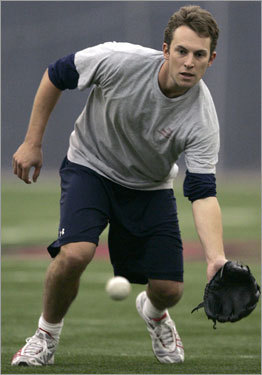
LHP Dustin Richardson (John Tlumacki)

Richardson and Buchholz (John Tlumacki)

SS Jed Lowrie (Charles Krupa)

RHP Devern Hansack (Charles Krupa)

So, ready for Spring Training?

Rotoworld Ranks Most Valuable Starters for 2008

Rotoworld ranked the top 75 starting pitchers of 2008. Keep in mind, this list ranks the most valuable starting pitchers for a fantasy league, not a major league baseball team. Although, given that fantasy leagues are based on the statistical produciton of major league players, the list does in a way rank how valuable these starters are.

On the list were Red Sox starters Josh Beckett (6), Dasiuke Matsuzaka (14), Curt Schilling (49) and Clay Buchholz (69). It seems as if most people expect a much better season from Daisuke next year. In the "overrated file" you'll find Chamberlain, Carmona, Penny, Harden, Garza, Willis, Wang, Hughes and Zambrano.

I'm itching for some prospect lists as well, but most of the more respected ones aren't released until late February.

An Alternative Take On Manny

The Ump Bump wrote a story about their thoughts on Manny's production next year, and his chances of retiring with the Red Sox. It's definitely worth a read if you have the time. If you don't, I'll summarize the important points.

"Under that baggy, pajama-like uni, the man is rock-hard."

Manny getting into great shape this offseason isn't much of a factor, he's always in great shape. His injuries are likley the result of his age, not him being out of shape.

"To me, he’s an easy first-ballot Hall of Famer. If he retires with Boston, they’re sure to retire his number. Is he really going to walk away from that? And is Theo really going to let him? I don’t think so."

Ramirez has two rings with the Red Sox, and finally got through a year without asking to be dealt. He has the most history with the Red Sox and I agree that Epstein won't let a first ballot Hall of Famer walk away. I think Epstein wants to retain both Ramirez and Varitek until they retire. If either player leaves the Red Sox before retiring, Red Sox rules wouldn't allow for their numbers to be retired.

The Ump Bump's story was inspired by one over at MVN. The MVN article discusses the chances of Manny bouncing back next season, and quotes Peter Gammons on the subject. Sound familiar? If it does, that's probably because I used the same quote in an article on the same exact subject less than two weeks ago.