
The Red Sox made Brad Wilkerson an offer for a one year, $2 million deal with incentives. They'll likely have their yes or no answer by tomorrow as the deadline on their deal runs out today. I'm not a fan of Wilkerson, but he's one of the better options left for a bench player. If they can get him for only $2 million, I suppose it would be a success. He was seeking a 3-year deal worth $7 million a year.
Keith Foulke has auditioned for most teams. But he couldn't get his velocity over 84. Ouch. It's possible that he won't get an offer from any team. I think it's safe to say that he's not on the Red Sox radar anymore, if he ever was.
Roto Authority has a short article on Buchholz. The author projects Buchholz to have a 3.86 ERA and a WHIP of 1.32 next year. He says he wouldn't be surprised to see an ERA anywhere between 3.50 and 4.50 from the pitcher next year. Even the pessimistic number would be spectacular for a sixth starter.
A lot of people give Epstein credit for drafting and helping to develop what is currently rated as the second best farm system in baseball. But what he's done is truly amazing. Not only has he built a top-notch farm system, but he's managed to retain most of his prospects, and be ulta-cautious with them while still managing to win a second championship in four years. How many other teams would have shut down Papelbon and Buchholz in the heart of pennant races? Would they also have given Lester 17 starts to recuperate at the beginning of last year, while Julian Tavarez was a regular starter in the rotation?
Drafting players is only the beginning. Ensuring their healthy development involves so much more.
Showing posts with label Clay Buchholz. Show all posts
Showing posts with label Clay Buchholz. Show all posts
Thursday, January 24, 2008


Tuesday, January 22, 2008
The Great Debate!
 (Winslow Townson/Associated Press)
Jerry Crasnick opened up a huge can of worms when he dare uttered the words, "Joba Chamberlain vs. Clay Buchholz". He spoke to nine mystery personnel from the Eastern League, and reported that most of them preferred Chamberlain. And it's clear that Crasnick himself rather prefers the hefty Nebraska native. But he eluded to a great divide between talent evaluators, saying that Baseball America's Jim Callis and John Manuel are so divided on the issue, that they should duke it out in a steel cage match.
A was a bit surprised to read that there is so much debate, however, and I wonder how much of this is Callis trying to create a story. From everything I've read up until this point, Buchholz seemed rather decisively to be the preferred pitcher. Every ranking of MLB prospects that I've seen, including the rankings on Scouting Book, have ranked Buchholz as the best pitching prospect in all of baseball. And John Sickels of minorleagueball.com has echoed that sentiment. And I'll be surprised if the prospect rankings of Baseball America and Baseball Prospectus agree. But that doesn't mean the issue can't be discussed.
Clay Buchholz
The greatest strength of Buchholz is that he has three plus pitches. His strongest, and best strikeout pitch is his straight changeup. His second best pitch, which is also quite the strikeout pitch, is his dramatic hard 12-6 curve. And his third best pitch is his two-seam fastball.
Many make the mistake of saying that his straight fastball is his best pitch, as that's the pitch that he can occasionally get up to 97 mph. But Buchholz probably uses his four-seam fastball only once for every three or four times he uses his four-seamer.
Buchholz has an extreme over-the-top delivery which puts extra downward movement all of his pitches. This often makes it difficult for hitters to square up with the ball. Buchholz mixes in his pitches very well, not over relying on any one pitch, and gets an equal amount of outs on the ground and in the air.
Joba Chamberlain
The greatest strength of Chamberlain is that he can throw the ball very hard. This doesn't just mean that he can get his fastball up to triple digits. He has late zip on his fastball, and the speed of his slider makes it a strong strikeout pitch. Although, as a starter, Chamberlain's velocity will go down. Before making the change to the bullpen, Joba's fastball typically sat around 92-95 mph.
Unlike Buchholz, Chamberlain doesn't have a plus third pitch. And how he continues to develop his curveball and changeup, will likely have quite a bit to do with his future success at the major league level. Even Crasnick, who likes Chamberlain quite a bit, said that his curveball on a good day is only "above average" and on some days it's actually rather bad. Crasnick referred to Joba's changeup as a work-in-preogress. It is likely his worst pitch.
It will be interesting to see how Chamberlain mixes in his pitches as a starter, as it wasn't really something he had to do out of the pen. If he relies almost exclusively on his fastball and slider, the results could be like those of Randy Johnson in 2006.
One minor issue with Chamberlain, which doesn't exist with Buchholz, is his history of injuries. Chamberlain was quite heavy in college, and used rather heavily in the Big 10. He does have more wear on his body than the typical 22-year-old and he has had multiple injuries. It may not help that new Yankees manager Joe Girardi has a history of overworking his starters, as he did with Marlins pitchers Scott Olsen and Anibal Sanchez.
Conclusions
I think Chamberlain could immediately be a shut-down reliever at the major league level. But as a starter in 2008, he will be learning on the job. The reality of the situation is that Joba's third pitch is still pretty raw, and he may have had backwards development in it as a reliever in 2007.
I think Buchholz is a question mark as well, although I think he's proven more as a starter. I don't think it's transition to the role will be quite as rough. It's easy to be excited about these pitchers but they are very young and will be on limited innings workloads. I think a lot of people overestimate the kind of impacts these players will have in 2008.
Friday, January 18, 2008
Francona Discusses Red Sox Rotation
 (Jim Davis)
According to Francona, the Red Sox will begin their rotation with Josh Beckett and Daisuke Matsuzaka. Although, Matsuzaka's wife may be having a child while the Red Sox are in Japan, so Matsuzaka may not be able to pitch in the second game of the season. I think it would be a real shame if Matsuzaka can't make the trip to Japan. It would be exceptional to see him pitch in front of his fellow countrymen who idolize him so much.
The Red Sox will play three exhibition games after they come back from Japan. Those exhibition games will allow them to use their top two starters not only in the first two games of the season, but also the third and fourth game of the season. The number three, four and five pitchers for the Red Sox will pitch in the exhibition games.
Francona also talked about the back of his rotation. Wakefield will begin the season as the team's number four starter. And Lester and Buchholz will compete for the fifth spot in the rotation. Given pitching coach John Farrell's strong like of Jon Lester, I'd be surprised if he didn't start the season in the rotation. But both Lester and Buchholz do have minor innings concerns. Their total workload will likely be capped somewhere around 180 innings each.
It's good to have Clay Buchholz, considered by most to be the best pitching prospect in baseball, as a backup starter. He could likely provide some high quality replacement innings for any other pitcher in the organization who either struggles or gets injured. Even though I think it's likely that Buchholz will start the season outside of the Red Sox rotation, if he pitches anything like he did last year, I'm sure he'll find a way onto the roster.
Tuesday, January 15, 2008
Red Sox Rookie Program
The Red Sox are currently holding their second annual Rookie Program. The program is designed to help prepare some of the team's best upper level talents for the major leagues. It involves work outs, drills, and programs to prepare the players for the pressures of the major leagues.
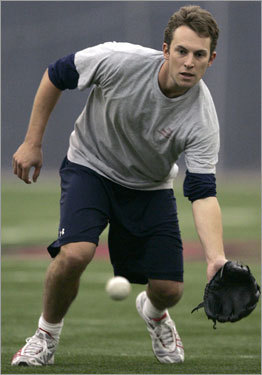
Clay Buchholz is visibly larger than he was this time last year. He's put on about 13 pounds in preparations for the wear of a full major league season. Devern Hansack was also invited to the program. He's a great story, being one of the few natives of Nicaragua ever to play in the majors. But other than that, there isn't too much news to come out of the program.
The Boston Globe did have some good pictures of the workouts and drills though.
 LHP Dustin Richardson (John Tlumacki)
 Richardson and Buchholz (John Tlumacki)
 SS Jed Lowrie (Charles Krupa)
 RHP Devern Hansack (Charles Krupa)
Clay Buchholz is visibly larger than he was this time last year. He's put on about 13 pounds in preparations for the wear of a full major league season. Devern Hansack was also invited to the program. He's a great story, being one of the few natives of Nicaragua ever to play in the majors. But other than that, there isn't too much news to come out of the program.
The Boston Globe did have some good pictures of the workouts and drills though.
 LHP Dustin Richardson (John Tlumacki)
 Richardson and Buchholz (John Tlumacki)
 SS Jed Lowrie (Charles Krupa)
 RHP Devern Hansack (Charles Krupa)
So, ready for Spring Training?
Saturday, January 12, 2008
Minor League Comparables: Clay Buchholz
 (Winslow Townson/AP)
According to Sox Prospects, Clay Buchholz is like a right-handed Cole Hamels. And I can see why they arrive at such a conclusion. Both pitchers are 6'3'' and weight 190 pounds, and Buchholz is only 7.5 months younger. And both pitchers posses 90+ mph fastballs, notoriously nasty changeups and solid, above average curves.
Then there are a few differences. Clay doesn't walk as many batters. In the minors, Clay walked 2.43 hitters for every 9 innings of work, Cole walked 3.31. Clay's fastball is also about 5 mph faster and his curveball is more developed. And of course Clay has a completely clean injury history, something rather rare for young pitchers.
On the other hand, Cole has much more major league experience. He's also stuck out more batters over his minor league career. Some may attribute this to the fact that he pitched in the Florida State League for much of his minor league career. But I think it probably has to do more with the fact that Hamels pitched less than 50 innings above the Single-A level while Buchholz pitched more than 200.
The difference in Hamels' upper level minor league experience could have made the transition to the majors a little more challenging for him. Although, Hamels did pretty well right away. He had a 4.08 ERA, a 1.25 WHIP and solid peripherals in his rookie year.
If you're looking for the pitcher with the most similar minor league numbers to Buchholz, that would probably be Jake Peavy. Peavy had an ERA of 2.60, a H/9 of 6.83, a BB/9 of 3.18 and a K/9 of 11.31 over his minor league career. Buccholz had an ERA of 2.46, a H/9 of 6.60, a BB/9 of 2.43 and a K/9 of 11.23. I don't think there's a single minor league line from this decade that's as comparable to that of Buchholz's.
Peavy didn't have as smooth a transition to the major leagues. Unlike Buchholz, Peavy struggled in his first major league starts. By his sophomore year, however, he was putting up solid top of the rotation numbers.
Peavy's frame is also similar to that of Buchholz. Peavy's about two inches shorter and 10 pounds lighter. The velocity on Peavy's fastball is more comparable to Clay's however. And he's another pitcher whose best pitch is a plus changeup.
If any of you have more thoughts, or other young/minor league pitchers who you think are comparable to Buchholz, feel free to let me know in the comments. I welcome any suggestions, and am happy to discuss who Buchholz might compare to, or how he may perform at the major league level.
Thursday, January 10, 2008
John Farrell An Unsung Hero of 2007
 (Brita Meng Outzen/MLB.com)
In 2006, Red Sox pitching was utterly embarrassing. Their staff ranked fifth to last in ERA and was below major league average in quality starts, batting average against, total walks, complete games and shut outs. Although the Red Sox finished third in the AL East, their pitching staff was more comparable to those of basement dwelling teams.
In 2007, the Red Sox saw dramatic improvement in their pitching staff. Among other American League teams, the Red Sox staff's ERA, WHIP and BAA went from 10th or worse to first. The staff's overall walk total decreased by 27 and their strikeout total increased by 79. Newcomers Diasuke Matsuzaka and Hideki Okajima helped, but for the most part the Red Sox returned the same pitching staff from 2006. Of the 13 pitchers who made significant contributions in 2007 (at least 35 innings), all but two of them were holdovers from 2006.
So what was the largest difference to the Red Sox pitching staff in 2007? I'd like to make the case for new Red Sox pitching coach John Farrell. First of all, I'll provide a quick background on Farrell. Outside of college baseball he had never coached before 2007. He did serve as the Director of Player development for the Cleveland Indians starting in late 2001. He helped the organization to have 2003's top rated farm system according to Baseball America.
He left the Indians organization to become the Red Sox pitching coach last year, and already he's made some serious waves. In Spring Training, Farrell worked with Josh Beckett to help him standardize his delivery. Beckett posted his lowest BB/9 since he was drafted and had a career year at the major league level.
Farrell also worked with new pitcher Hideki Okajima. In the humidity of Florida Spring Training, Okajima had trouble with his changeup. So Farrell helped him to devliver a new grip on his changeup, which would create more movement. The result was the creation of Okajima's split-change nicknamed the "Okie Doke". And against major leaguers in 2007, Okajima had a lower WHIP than he ever had in the 11 years that he faced Japanese hitters.
Under the tutelage of Farrell, young pitchers Jon Lester and Manny Delcarmen also saw positive improvements in their development. I'm not sure if Jonathan Papelbon really needed all that much tutelage, but in 2007 he lead the majors in K/9 innings pitched.
In 2008, Farrell will look to continue the development of young Red Sox pitchers. Farrell has fallen in love with Jon Lester, and seems determined to make the young lefty his next project. But I'm sure Farrell will also work extensively with Daisuke Matsuzaka and Clay Buchholz. And God forbid if Farrell works on Beckett any more, that would just be unfair.
Tuesday, January 1, 2008
Top 5 Red Sox Prospects
 1. Clay Buchholz, 23-Year-Old RHP
Clay Buchholz might just be the best pitching prospect in baseball, so he's a shoo-in for best Red Sox prospect. Buchholz to this point in his career has done everything right. Throughout the minors, he walked only 2.43 batters and struck out 11.23 hitters in every nine innings of work.
What makes Buchholz so special is the strength of his secondary pitches. The young pitcher's fastball sat in the low-90's for most of his career. At the end of 2007, however, Buchholz's fastball was sitting at 96 mph and it's his third best pitch. His arsenal of secondary pitches is what will likely make him an affective major league pitcher.
That arsenal includes two change ups, a curve ball, and a slider. His straight change up is his best out pitch. It sits at around 80 mph, about 15 mph off his fastball. Buchholz also possesses a strike out 12-6 curve ball which buckles the knees of hitters. For reference, see the last out of Buccholz's no-hitter, in which Nick Markakis sat helplessly with his bat on his shoulder.
 2. Jacoby Ellsbury, 24-Year-Old CF
After being a World Series hero, winning the Rookie of the Year Award doesn't sound all that exciting. But going into the season, Ellsbury is one of the most likely candidates. He's all a team could ask for in a leadoff hitter and center fielder. He's a left-handed slap hitter, who consistently puts the ball in play, gets on base, and advances on the bases once he gets on.
Ellsbury's also a defensive center fielder worthy of taking over for Coco Crisp. While he's not quite at Crisps's level, he's still one of the best defensive center fielders in the majors. His arm is only average, but it's pretty accurate. After Crisp and Damon, any arm at all is an improvement.
As of yet, Ellsbury doesn't have much power, but he is young. If he eventually develops 15-20 home run power, he has the potential to be one of the best center fielders in the majors. But as of now, his OBP and speed work perfectly at the top of the Red Sox batting order, even if he isn't going to hit home runs.
 3. Jed Lowrie, 23-Year-Old SS
Lowrie possesses the plate discipline typical of so many Red Sox position players. Over his minor league career, he's gotten on base at a rate of .386. What makes Lowrie especially valuable though, is his developing power.
Lowrie slugged over .500 last year in significant time at both Double-A and Triple-A. That degree of power is incredible for a middle infielder. In fact, only 5 middle infielders slugged .500 or batter last year at the major league level. Lowrie's power, combined with the fact that he's a switch hitter, makes him a valuable commodity. So the Red Sox might look to capitalize on his trade value while it is high.
Defensively, Lowrie is an average shortstop. He could be the Red Sox shortstop of the future, but the Red Sox would like him to improve on his throwing accuracy. If he is dealt to Minnesota, he would likely start the major league season as a second baseman where his throws would be shorter.
 4. Justin Masterson, 22-Year-Old RHP
Like any sinkerball pitcher, Masterson's career success is difficult to predict. But Masterson isn't the typical sinkerballer. He allows very few hits or walks, and has struck out more than a hitter an inning at every stop but Lancaster, which is notorious for being hitter friendly. Masterson's upside is tremendous.
Similar to Derek Lowe, Masterson has shown great potential both as a starter and reliever. Masterson has the strange ability to vary the speed of his sinker from 84-94, and he gets an insane amount of ground balls. He has a good slider, and a work-in-progress changeup. If he develops those pitchers further, he could make a quality top of the rotation starter.
Even at this point in Masterson's development however, he may be able to play a major league role similar to that of Julian Tavarez. Based on a team's needs, Masterson could be an average reliever or a back of the rotation starter.
 5. Ryan Kalish, 19-Year-Old CF
At only 19 years of age, Kalish is already a four-tool-athlete, with the build to possibly develop power as well when he ages. Kalish was just drafted in 2006, and the organization worked with him quite a bit prior to his 2007 season. The work appears to have paid off. Looking at Kalish's Single-A line of .368/.471/.540, you'd think he played at Lancaster, but he in fact put those numbers up over 87 at bats in Single-A Lowell.
Kalish is a very exciting player for his age. He's got all the raw talent, including the ability to steal 18 bases last year in 23 games. If he develops the mental aspect of his game to match his physical abilities, he could have a bright future. He probably projects best as a right-fielder for the Red Sox, given his strong arm. If the Red Sox are patient with him and give him a full year at every level of the minors, he might be ready to take over for Drew in 2012, or perhaps even sooner.
Friday, December 21, 2007
Buchholz Ranked As Top Pitching Prospect In Baseball
Scouting Book ranked Buchholz as the number one pitching prospect in baseball, and the number three prospect overall. He was ranked behind only Reds outfield prospect Jay Bruce and St. Louis prospect Colby Rasmus. I'm eager to see rankings from other sites such as Baseball Prospectus.
Scouting Book also ranked other Red Sox prospects. Other member of the Red Sox who were on the list include Jacboy Ellsbury (22nd), Lars Anderson (45th), Justin Masterson (47th), Michael Bowden (50th), Jed Lowrie (70th), Oscar Tejeda (90th), Daniel Bard (110th), and Craig Hansen (119th). Wait, Craig who?
Scouting Book also ranked other Red Sox prospects. Other member of the Red Sox who were on the list include Jacboy Ellsbury (22nd), Lars Anderson (45th), Justin Masterson (47th), Michael Bowden (50th), Jed Lowrie (70th), Oscar Tejeda (90th), Daniel Bard (110th), and Craig Hansen (119th). Wait, Craig who?
Thursday, December 20, 2007
Buchholz vs. Hughes
 Sorry if that title's misleading. I don't mean for this post to be a pissing match between Red Sox and Yankees fans, each claiming that their pitcher is superior. I would encourage discussion regarding the two pitchers, but this post isn't truly meant as grounds for comparing the two pitchers So, in case you were wondering what inspired the title, here it is.
Keith Law had an open chat today. One of the participants was a Yankees fan from New Jersey, who wrote in with the following question.
"Merry X-mas Keith… Anyone who thinks bucholz is equal to hughes has never looked at anything but a box score… Their pure stuff is comparable, but before the injury, Hughes had a slight edge all around, but hughes is also three years younger and still developing physically. Bucholz is where he’s going to be physically, especially in terms of power (which translates to break on his secondary pitches). Scouts having followed them consider Hughes to be a more intelligent, polished pitcher, despite being younger. Hughes has no personality issues, and showed in the playoffs that he can step into a big spot and come up even bigger. Bucholz has already been arrested and is a spoiled rich kid who thinks he can get away with anything. Hughes mechanics are considered fairly sound, none of his pitches thought to be serious injury risks. Bucholz mechanics on his breaking balls are ‘whippy’ and put a lot of torque on his arm. there is a lot of question how, especially as thin as he is, if his arm will hold up. so… even if there stuff is comparable, age, polish, mechanics, body… all go in favor of hughes… it’s why he was the highest rated pitching prospect in baseball coming into 07."
Keith Law then responded with the following:
"Merry Christmas to you too. I have zero idea where you get any of this from. Buchholz’ raw stuff > Hughes’. When Hughes has two secondary pitches as good as Buchholz’ curve and change, you give me a call, OK?"
Now I've heard many Yankees fans tell me that scouts value Hughes more than Buchholz. But who are these scouts? To be honest, I don't care what scouts have supposedly said. When you read scouting reports it's often unclear when the scouts have done the reports or what organizations these scouts may be affiliated with. Anyone can go out and find a scout who thinks their guy is the real thing. I prefer to rely on my one eyes, not the eyes of some other, semi-anonymous person.
Keith Law seems to be equally confused by who these "scouts" are, and how their opinions are relevant, or accurate. He makes the point that Buchholz does have some incredible secondary pitches. Anyone who saw Buchholz pitch in the majors last year can attest to how filthy his changeup and curve looked.
And I found it humorous how quick the fan was to attack Buchholz' "character issues." Funny how a one time incident when the pitcher was in high school is indicative of character issues. If a one time incident by a high school student is indicative of character issues, then what does that say of Andy Pettitte? Did he not show a one time lack of good judgment ate age 30, when he was an adult major league pitcher who took hGH?
Furthermore, Yankees prospects have been infamously overrated for years. Remember when pitchers like Brien Taylor, Mark Hutton and Sterling Hitchcock were supposed to be the next big things in the early 90's? Not one of them turned out to be the top of the rotation starters they were billed as.
 The Yankees play in New York City, their prospects will always have more hype surrounding them, especially in times when the major league team hasn't brought home in a championship in a while. But the reality of the situation is, regardless of how great a name Melky Cabrera has, he still barely outhit Coco Crisp last year, by .006 points in OPS and he's an average defensive player. Maybe it's just me, but I find it hard to be excited about anyone who hits like Coco Crisp.
I think it's rather mundane to try to claim either pitcher is better than the other. They're in their low 20's and neither one has pitched even half a season at the major league level. Both are works in progress and fans of either pitcher will only see what they want to. The issue of which pitcher is better is one that we will all have to wait to observe.
Friday, December 7, 2007
Jon Lester's Ceiling
 I have a friend, who for the life of him couldn't understand they the Minnesota Twins would be interested in a deal centered around Jon Lester. I tried to explain to him the potential of Jon Lester. There's no arguing about Lester's stuff - it's great. When Lester first came up to the Double-A level in 2005, he posted an ERA of 2.61 while striking out 163 batters over 148.1 innings of work.
Going into that season of 2005, Baseball America ranked Lester as the Red Sox fourth best prospect, one spot behind Jonathan Papelbon. After the 2005 season, Baseball America ranked Lester as the Red Sox second best prospect, behind only Andy Marte. Marte was only a member of the Red Sox for a small period of time, and was later dealt to the Indians for Coco Crisp. So for all intensive purposes, Lester was ranked as the organization's best prospect, at any position.
In 2006, Lester was promoted to Triple-A where he again was very successful. In just over 46 innings, Lester had an ERA of 2.70, while striking out 43 hitters. On the surface, Lester looked poised to make the leap to the majors. And Lester did on June 10th. Lester even went on to win his first five decisions, and five of his first seven starts. Over those starts, his ERA as low as 2.38. ESPN compared the young lefty to other young pitchers Jered Weaver and Francisco Liriano. Lester's success, however, masked a major issue in his development.
Starting with Lester's promotion to Triple-A in 2006, his control began to suffer greatly. His walk rate jumped to 4.82 walks every nine innings of work. When he stopped hitting his spots, the typically precise pitcher saw his hit rate, home run rate and WHIP rise as his strikeout rate took a slight dip.
Lester's poor control is what now sets him apart from Type A pitching prospects such as Clay Buchholz and Phil Hughes. This can be demonstrated by a quick comparison of their walk rates at the Double-A level. I chose the Double-A level because it's the only level at which any of these pitchers have thrown at least 85 innings.
In 2005, Lester walked a batter every 2.6 innings of work at the Double-A level. At the same level, in 2006, Hughes walked a batter every 3.63 innings of work. This year at the Double-A level, Clay Buchholz walked a batter every 3.95 innings of work. Over just 100 innings of work, that's a difference of 13 free passes between Lester and Buchholz, or difference in .13 in WHIP.
Exactly what caused Lester's loss of control is debatable. And it's not a matter to be taken lightly. The cause of his control issues could have a lot to do with his future level of success or failure. Some have argued that Lester's cancer may have played a role. Lester himself admits that his 2006 performance was affected by his cancer at some point in the season, although he doesn't say when. It was clear that by the time he came to the Red Sox in June of 2006, his velocity was down three or four miles per hour from where it typically was.
No one but Lester can know how much his illness affected his performance. Even if he was in perfect health, jumps in his walk rates aren't surprising for someone who had less than 50 innings of experience above the Double-A level, before going to the majors. In fact, a rise in walk rates is typical of most pitchers when they are promoted a level. These spikes in walk rates, however, are usually temporary. Some pitchers take longer than others to then get their walk rates down to normal levels. Some pitchers never reduced their elevated walk rates.
Whether Lester will be able to get his walk rate down in 2008 has yet to be seen. Lester now has a total of 118.1 innings of experience at the Triple-A level and 144.1 innings of experience at the major league level. Compared to his first major league stint, Lester now has over 200 more innings of experience above the Double-A level. Still, he wasn't completely healthy for much of that time.
One person who thinks Lester still has the potential to be a great starter is pitching coach John Farrell. Farrell has told the Red Sox management that he thinks Lester could win anywhere from 15-18 games once he's fully developed. In my opinion, Lester has the raw ability to do so. Last year, Lester kept his major league ERA down to 4.57, even while he walked nearly a better every other inning.
Without a significant improvement in control, however, Lester will never win 18 games. Throughout his minor league career, Lester averaged 3.78 walked per nine innings of work. When he keeps his walk rate below four walks every nine innings, he's been successful. His walk rate was below 4 BB/9 IP when he posted a 2.61 ERA at Double-A in 2005 and when he posted a 3.89 ERA at Triple-A last year. So a walk rate below 4 BB/ 9 IP is what I'm going to look for next year.
Who knows, perhaps he could live up to his potential next year. I think it will probably take him another half a year at least before he begins to realize his ability at the major league level. It could take him as long as two more years. Lester is only 23 years of age, and was hurt by being rushed to the majors, and enduring a year of poor health.
He's already shown he has heart, coming back from cancer to win the deciding game of the World Series. Now it's just a matter of putting the ball where he wants it to be. Not that that's an easy task. Major leaguers have long lived or died by their ability to do it. As they say, it's a game of inches.


