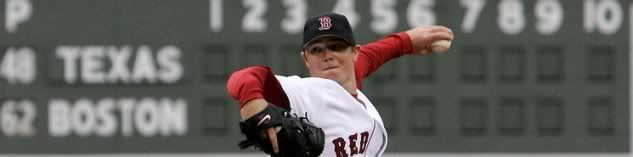
Showing posts with label Jon Lester. Show all posts

Sunday, January 20, 2008

The Polls Are Closed: What's Your Opinion On Santana?

The polls are now closed and well over 100 people have spoken. The second most popular selection in the poll was that neither Red Sox package of prospects was worth giving up for Santana. But 26 more voters (and 50% of the voters overall) said that they'd give up the Lester, Lowrie package for Santana. Only 9% of voters, however, were willing to give up Ellsbury and Lowrie in a package for Santana.

And I have to say that I actually agree with the results. While I would much prefer that the Red Sox keep Ellsbury, I would be happy with dealing Lester, Lowrie, Crisp and Masterson for Santana. I'm fully aware that Santana will come with a steep price tag, and I expect Lowrie to be a pretty good middle infielder for years to come. And Lester could potentially be a front of the rotation starter who costs more than $25 milllion a year less than Santana. But the addition of Santana to a Red Sox rotation consisting of Beckett, Matsuzaka, Schilling and Buchholz, is just too exciting to pass up. I don't think it's realistic to expect even the best of pitching prospects to be as good as Santana. A pitcher of Santana's caliber only comes around once an era, not once every few years.

If the Red Sox were to acquire Santana, I wouldn't expect him to put up 2004 numbers. He's not going to put up a WHIP of 0.92 facing AL East hitters in Fenway Park. And I doubt that Santana will ever strike out 265 batters in a season again. But I would expect Santana to be one of the best three pitchers in the American League over the next five years. And that would give the Red Sox an absolutely lethal pitching rotation.

Of course, Santana would take up quite a bit of payroll. And there is a rather high risk in taking on a six or seven year contract with any pitcher. Just Thursday, Buster Olney said that he heard from a talent evaluator who suspects that Santana might have a health issue. But that is of course speculation at this point. Most talent evaluators probably have a different explanation for Santana's sub-par season last year.

Friday, January 18, 2008

Francona Discusses Red Sox Rotation

(Jim Davis)

Red Sox manager Terry Francona fielded questions on Thursday at the Boston Baseball Writers' Assocation of America. And for those of you wondering about the Red Sox rotation in 2008, he answered almost every question you could have.

According to Francona, the Red Sox will begin their rotation with Josh Beckett and Daisuke Matsuzaka. Although, Matsuzaka's wife may be having a child while the Red Sox are in Japan, so Matsuzaka may not be able to pitch in the second game of the season. I think it would be a real shame if Matsuzaka can't make the trip to Japan. It would be exceptional to see him pitch in front of his fellow countrymen who idolize him so much.

The Red Sox will play three exhibition games after they come back from Japan. Those exhibition games will allow them to use their top two starters not only in the first two games of the season, but also the third and fourth game of the season. The number three, four and five pitchers for the Red Sox will pitch in the exhibition games.

Francona also talked about the back of his rotation. Wakefield will begin the season as the team's number four starter. And Lester and Buchholz will compete for the fifth spot in the rotation. Given pitching coach John Farrell's strong like of Jon Lester, I'd be surprised if he didn't start the season in the rotation. But both Lester and Buchholz do have minor innings concerns. Their total workload will likely be capped somewhere around 180 innings each.

It's good to have Clay Buchholz, considered by most to be the best pitching prospect in baseball, as a backup starter. He could likely provide some high quality replacement innings for any other pitcher in the organization who either struggles or gets injured. Even though I think it's likely that Buchholz will start the season outside of the Red Sox rotation, if he pitches anything like he did last year, I'm sure he'll find a way onto the roster.

Tuesday, January 15, 2008

With Winter Winding Down, Twins Aren't Any Closer To A Deal

I'm sorry, but if you're not entertained by the Santana Saga, then you haven't been paying attention. I feel like the Twins should be nominated for a Soapy Award at this point; although they'd have some stiff competition in Hank Streinbrenner. For those of you who haven't been paying attention, or are perhaps a little confused, here's a recap of the happenings the past few days.

On Friday, the Yankees reportedly weren't talking to the Twins about Santana. Then just yesterday, the Yankees repordetly talked to the Twins, but just to let them know that they took their offer off the table. Then less than eight hours later, Hank Streinbrenner weighed in to let everyone know that while "there was no official offer on the table at this time", he hasn't taken his offer off the table.


In case that left you confused as well, Hank did in fact clarfiy the statement. According to Howlin' Hank, he couldn't have taken an offer off the table because "there wasn't an official offer anyway." Sometimes I wonder if Hank just says whatever he thinks will get him the most attention.

So what's developed since yesterday? Well, more of nothing mostly. According to the Star-Ledger Staff, neither the Mets or Yankees appear willing to make a deal with the Twins unless they lower their demands. The Red Sox have been at that same stage in negotiations for some time. So what's this mean?

All three teams appear to have made their final offers. The Red Sox are offering a package of Jon Lester, Coco Crisp, Jed Lowrie and Justin Masterson and also a package of Jacoby Ellsbury, Jed Lowrie and Justin Masterson, but not a package containing both Lester and Ellsbury. The Yankees would offer a package of Phil Hughes, Melky Cabrera and Jeff Marquez, but not a package including both Hughes and Ian Kennedy. And the Mets are offering a package of Carlos Gomez, Kevin Mulvey, Phil Humber and Deolis Guerra but not a package including Carlos Gomez and Fernando Martinez.

Either team could quickly make a deal, by giving up the extra guy. But I don't see why any team would. The Red Sox likely believe that they have the best offer. Hank Streinbrenner has said that the thinks his team has the best offer. And the Mets probably don't feel a need to add a fifth prospect to their deal given the fact that they're the only National League team in the running, and they're Santana's desired landing point. Furthmore, they're probably the only team of the trhee with a realistic chance of being able to acquire Erik Bedard.

I seriously doubt that the Twins will go into the season without having dealt Santana. Whether he's bluffing or not, Santana has said that he won't accept a midseason trade. So if the Twins don't deal him before the season begins, the Twins run the risk of getting nothing but two sandwhich picks in the draft when Santana walks.

The Boston Herald, with the help of Baseball America, gave a run down on the three packages which the Twins could currently select from. The article classifies the Mets package as risky, given the fact that most of the players are years removed from being major league ready. The article also classifies the Yankees package as lightweight, given the fact that it includes one blue chip player and two throw-in caliber players.

And I think most fans outside of New York would agree with both statements. If the Twins want the safest return for Satnana, it would likely be the Red Sox package. The Red Sox package includes the most major league ready talent, and fills the most immediate needs for the Twins. The Yankees package offers the Twins a possible ace, but little else. And the Mets package offers the Twins the most overall talent, although little to none of it is major league ready.

For any Yankees fans worried about losing Phil Hughes, I wouldn't lose any sleep over it. Accepting a package of Hughes, Melky and Marquez probably wouldn't be in the best interests of the Twins. And there's absolutely no chance that the Yankees would give up both Phil Hughes and Ian Kennedy in a package for Santana. Although, if it's the Red Sox that acquire Santana, Yankees fans may be wishing otherwise for the next six or seven years.

Thursday, January 10, 2008

John Farrell An Unsung Hero of 2007


(Brita Meng Outzen/MLB.com)

In 2006, Red Sox pitching was utterly embarrassing. Their staff ranked fifth to last in ERA and was below major league average in quality starts, batting average against, total walks, complete games and shut outs. Although the Red Sox finished third in the AL East, their pitching staff was more comparable to those of basement dwelling teams.

In 2007, the Red Sox saw dramatic improvement in their pitching staff. Among other American League teams, the Red Sox staff's ERA, WHIP and BAA went from 10th or worse to first. The staff's overall walk total decreased by 27 and their strikeout total increased by 79. Newcomers Diasuke Matsuzaka and Hideki Okajima helped, but for the most part the Red Sox returned the same pitching staff from 2006. Of the 13 pitchers who made significant contributions in 2007 (at least 35 innings), all but two of them were holdovers from 2006.

So what was the largest difference to the Red Sox pitching staff in 2007? I'd like to make the case for new Red Sox pitching coach John Farrell. First of all, I'll provide a quick background on Farrell. Outside of college baseball he had never coached before 2007. He did serve as the Director of Player development for the Cleveland Indians starting in late 2001. He helped the organization to have 2003's top rated farm system according to Baseball America.

He left the Indians organization to become the Red Sox pitching coach last year, and already he's made some serious waves. In Spring Training, Farrell worked with Josh Beckett to help him standardize his delivery. Beckett posted his lowest BB/9 since he was drafted and had a career year at the major league level.

Farrell also worked with new pitcher Hideki Okajima. In the humidity of Florida Spring Training, Okajima had trouble with his changeup. So Farrell helped him to devliver a new grip on his changeup, which would create more movement. The result was the creation of Okajima's split-change nicknamed the "Okie Doke". And against major leaguers in 2007, Okajima had a lower WHIP than he ever had in the 11 years that he faced Japanese hitters.

Under the tutelage of Farrell, young pitchers Jon Lester and Manny Delcarmen also saw positive improvements in their development. I'm not sure if Jonathan Papelbon really needed all that much tutelage, but in 2007 he lead the majors in K/9 innings pitched.

In 2008, Farrell will look to continue the development of young Red Sox pitchers. Farrell has fallen in love with Jon Lester, and seems determined to make the young lefty his next project. But I'm sure Farrell will also work extensively with Daisuke Matsuzaka and Clay Buchholz. And God forbid if Farrell works on Beckett any more, that would just be unfair.

Saturday, January 5, 2008

2008 Red Sox Pitching Projections - Starters

(Brian Snyder/Reuters)

So I just got my hands on a copy of the Bill James Handbook. It's become an annual tradition for me to view the information in it. Others might find it boring, but for me it provides some interesting food for thought when I'm in desperate need for baseball. I'm going to be discussing a lot of information in the book over the next few weeks. To begin the discussion I thought I'd look at the projections for the Red Sox starting pitchers. Here are the projections, coupled with my thoughts.

Josh Beckett - 3.50 ERA, 1.22 WHIP (203 IP, 184 H, 64 BB, 187 SO)

I was a little surprised to see such a high ERA projection, even though 2007 was a career year for Beckett. Since his rookie season, Beckett's posted an ERA on the lower side of 3.50 most of the time. Other than Beckett's atypical 2006 season, Beckett's BB/9 IP has gone down every year, yet the projection expects it to go back up in 2008.

I can understand why the projection is so high, as projections must give weight to Beckett's 2006 season. But most indications point to 2006 being an off year and 2007 being an indicator of improving ability at the major league level as he enters the prime ages of most pitchers' careers.

Daisuke Matsuzaka - 3.54 ERA, 1.23 WHIP (
193 IP, 173 H, 64 BB, 184 SO)

I was surprised by these numbers too, but this time because of how low they were. But I can understand why the projection would like Daisuke so much. These numbers are similar to the ones he posted before he wore down late in the season. Matsuzaka had an ERA of 3.84 and a WHIP of 1.24 in the first half of 2007. Daisuke's ERA was as low as 3.59 on August 10th. You also have to consider that 2007 was Matsuzaka's rookie season.

Curt Schilling - 3.54 ERA, 1.16 WHIP (160 IP, 161 H, 25 BB, 150 SO)

I was quite surprised by this projection as well. Schilling hasn't posted a year like this since 2004, and he's not getting any younger. It's not that Schilling didn't have a very good year in 2007 (3.87 ERA, 1.25 WHIP). But why is his 2008 expected to be such an improvement? His projection seems to think there will be drastic drops in his hits rate and a drastic improvement in his strike out rate.


Tim Wakefield -
4.03 ERA, 1.31 WHIP (181 IP, 174 H, 63 BB, 123 SO)

Wakefield is up and down year to year but it's been a while since he's put up some numbers like these. Either the Bill James Handbook thinks Wakefield the fountain of youth, or they just assume every pitcher over 40 uses performance enhancers.

Jon Lester - 4.42 ERA, 1.55 WHIP (175 IP, 183 H, 89 BB, 149 SO)

It's easy to get excited about Lester given his raw stuff, but this is probably a fair projection for 2008. The numbers aren't great but they're about league average for a starter.

Clay Buchholz

Although Buchholz figures to play a large role in the Red Sox rotation, the Bill James Handbook could not project his statistics based on such a small major league sample size.

Friday, January 4, 2008

Lester's A Popular Guy

(AP Photo/Winslow Townson)

Most Red Sox fans probably know how high pitching coach John Farrell is on Jon Lester. Farrell is a strong advocate for keeping the young lefty. He's said that if the Red Sox keep Lester, he "will be counted on heavily once spring training opens."

But Farrell isn't the only one who has flattering things to say about Lester. The 23-year-old pitcher has also garnered praise from outside of the organization. Peter Gammons describes that
"after the Cleveland series, the Indians front office, coaches, and player personnel people had a meeting and it was unanimously agreed that after Josh Beckett, the best pitcher on the Red Sox was Lester. That doesn't include Papelbon, different category"

It will be interesting to see what Lester can do next year. He hasn't been at full strength for the better part of the last two years. Peter Gammons cites the fact that Lester's velocity hasn't been normal for some time, and he's not the only one to point that out.

Over Lester's first two years in the Red Sox farm system, his fastball sat in the low 90's and topped out in the mid-90's. But by the time was called up to the Red Sox in 2006, his fastball was sitting in the high 80's and was topping out in the low 90's.

Lester was weak and losing weight. Until he was diagnosed with cancer months later, he didn't understand why. According to Lester, he still weighs himself routinely to assure himself that he isn't relapsing.

Tuesday, January 1, 2008

The Polls Are Closed: How Many Wins Will Lester Get?

With more than 100 responses, 11-15 wins was the most popular choice by far, earning almost half of the total votes. Win totals can often be a crap-shoot. How many wins Lester will get next year depends quite a bit on what team he plays for. But I can see why most people thought Lester would win 11-15 games.

In 144.1 career innings, Lester is 11-2. Next year, Lester will likely get 30-40 more innings, and he'll be a year more adjusted to the majors as well as a year more removed from cancer and chemotherapy. Maybe it's skill, maybe it's luck, maybe it's both, but Lester has put up good win totals over his short major league career.

For what it's worth, from 2006 to 2007, Lester lowered his ERA by 0.19, his WHIP by 0.19, and his BAA by .038. But like I've said many times before, he needs to get his walk rates down and he only improved them marginally from 2006 to 2007. I look forward to seeing what he can do in 2007 when he's completely healthy, regardless of what team he's playing for.

Sunday, December 23, 2007

Santana - Why the Red Sox Package Makes Sense

When news of a possible Santana deal first broke, Peter Gammons speculated that it would take a package including Chien-Ming Wang or Robinson Cano, plus a premium prospect. Months later, the Twins are struggling just to get a premium prospect. I think it's fair to say that the demand for Santana isn't as high as many expected it to be.

This is likely due to a few factors. First of all, the salary that Santana would command really limits to the teams he could be dealt to. And the list of teams that the Twins could match up with in a trade is even further limited by Santana's no-trade clause. It's unclear which teams Santana would accept being dealt to, but most likely due to financial restrictions, only a few teams showed serious interest in Santana: the Mets, Red Sox, and Yankees.

As for a Mets, they simply didn't have the prospects to be a good match. And so any Santana deal would require them to give up a major piece of their major league team such as Jose Reyes. To no one's surprise, the Mets didn't bite.

As for the Yankees, Brian Cashman has become very conservative about trading young prospects. The Twins had to fight so hard to get Phil Hughes included in a deal, that once the did, the Yankees were unwilling to budge on any more talent. The best package that the Yankees seem willing to provide is a rather weak package of Phil Hughes, Melky Cabrera, and Jeff Marquez. And if Cashman had his way, Hughes wouldn't even be on the table.

So that leaves the Twins with the Red Sox. Like other teams, the Red Sox aren't willing to offer a star major league player in return for Santana. But the Red Sox do offer one thing that other teams don't, multiple quality prospects in Jon Lester, Jed Lowrie and Justin Masterson. In addition to offering multiple quality prospects, the players the Red Sox are offering, would also fill the most holes for the Twins.

The Twins need a center fielder, a middle infielder, and since they've already dealt Matt Garza, they could use multiple pitching prospects. Ideally, those pitching prospects would be able to help out the major league team either in 2008, or fairly soon after.

The quantity available in the Red Sox package makes sense for the Twins for multiple reasons. First of all, the more cost controlled players the Twins receive in a deal, the more money they'll be saving on the free agent market. This has to be an utmost concern for a cost conscious team such as the Twins.

By dealing Santana for multiple quality prospects, it also diversifies the Twins investment. You could consider Johan Santana capital, and the Twins would be trading in that capital for stocks, which the they hope develop into good investments. Well, if the Twins were to trade Santana for Phil Hughes, Melky Cabrera, and Jeff Marquez, what would happen if Hughes didn't work out as well as he's projected to? They'd lose almost all of the value that they received in the deal.

On the other hand, if the Twins were to acquire Jon Lester, Jed Lowrie and Justin Masterson, they could still get a good deal of value out of the deal if one of those prospects didn't work out. Would the Twins be getting equal value for Santana? No. But the Twins are in a rather odd position in that regard.

If the Twins do not trade Johan Santana, they would not be able to afford him when he hits the free agent market next year. And if Santana leaves via free agency, which he almost certainly would, the Twins would receive only two sandwich draft picks for compensation. That chances of those draft picks being as valuable as Jon Lester, Coco Crisp, Jed Lowrie and Justin Masterson are very remote.

The Twins could go into the season with Santana, hoping to trade him at the deadline, but Santana has said that the wouldn't allow a trade mid-season. So the Twins will likely have to take whatever the best offer is on the table going into next season. Currently, that offer appears to be that of the Red Sox, and there are no indications that other teams are willing to offer a better deal.

I expect the Twins to play poker a little longer, hoping the Red Sox will up their offer with the inclusion of Jacoby Ellsbury. In the end, however, the Twins will likely have to give up their bluff, as they aren't the ones holding the cards. They simply don't have the money to afford Santana, so they'll have to get the best value possible for him. And in order to do that, they'll have to trade him soon, even though it's not the best market for him.

Friday, December 7, 2007

Jon Lester's Ceiling

I have a friend, who for the life of him couldn't understand they the Minnesota Twins would be interested in a deal centered around Jon Lester. I tried to explain to him the potential of Jon Lester. There's no arguing about Lester's stuff - it's great. When Lester first came up to the Double-A level in 2005, he posted an ERA of 2.61 while striking out 163 batters over 148.1 innings of work.

Going into that season of 2005, Baseball America ranked Lester as the Red Sox fourth best prospect, one spot behind Jonathan Papelbon. After the 2005 season, Baseball America ranked Lester as the Red Sox second best prospect, behind only Andy Marte. Marte was only a member of the Red Sox for a small period of time, and was later dealt to the Indians for Coco Crisp. So for all intensive purposes, Lester was ranked as the organization's best prospect, at any position.

In 2006, Lester was promoted to Triple-A where he again was very successful. In just over 46 innings, Lester had an ERA of 2.70, while striking out 43 hitters. On the surface, Lester looked poised to make the leap to the majors. And Lester did on June 10th. Lester even went on to win his first five decisions, and five of his first seven starts. Over those starts, his ERA as low as 2.38. ESPN compared the young lefty to other young pitchers Jered Weaver and Francisco Liriano. Lester's success, however, masked a major issue in his development.

Starting with Lester's promotion to Triple-A in 2006, his control began to suffer greatly. His walk rate jumped to 4.82 walks every nine innings of work. When he stopped hitting his spots, the typically precise pitcher saw his hit rate, home run rate and WHIP rise as his strikeout rate took a slight dip.

Lester's poor control is what now sets him apart from Type A pitching prospects such as Clay Buchholz and Phil Hughes. This can be demonstrated by a quick comparison of their walk rates at the Double-A level. I chose the Double-A level because it's the only level at which any of these pitchers have thrown at least 85 innings.

In 2005, Lester walked a batter every 2.6 innings of work at the Double-A level. At the same level, in 2006, Hughes walked a batter every 3.63 innings of work. This year at the Double-A level, Clay Buchholz walked a batter every 3.95 innings of work. Over just 100 innings of work, that's a difference of 13 free passes between Lester and Buchholz, or difference in .13 in WHIP.

Exactly what caused Lester's loss of control is debatable. And it's not a matter to be taken lightly. The cause of his control issues could have a lot to do with his future level of success or failure. Some have argued that Lester's cancer may have played a role. Lester himself admits that his 2006 performance was affected by his cancer at some point in the season, although he doesn't say when. It was clear that by the time he came to the Red Sox in June of 2006, his velocity was down three or four miles per hour from where it typically was.

No one but Lester can know how much his illness affected his performance. Even if he was in perfect health, jumps in his walk rates aren't surprising for someone who had less than 50 innings of experience above the Double-A level, before going to the majors. In fact, a rise in walk rates is typical of most pitchers when they are promoted a level. These spikes in walk rates, however, are usually temporary. Some pitchers take longer than others to then get their walk rates down to normal levels. Some pitchers never reduced their elevated walk rates.

Whether Lester will be able to get his walk rate down in 2008 has yet to be seen. Lester now has a total of 118.1 innings of experience at the Triple-A level and 144.1 innings of experience at the major league level. Compared to his first major league stint, Lester now has over 200 more innings of experience above the Double-A level. Still, he wasn't completely healthy for much of that time.

One person who thinks Lester still has the potential to be a great starter is pitching coach John Farrell. Farrell has told the Red Sox management that he thinks Lester could win anywhere from 15-18 games once he's fully developed. In my opinion, Lester has the raw ability to do so. Last year, Lester kept his major league ERA down to 4.57, even while he walked nearly a better every other inning.

Without a significant improvement in control, however, Lester will never win 18 games. Throughout his minor league career, Lester averaged 3.78 walked per nine innings of work. When he keeps his walk rate below four walks every nine innings, he's been successful. His walk rate was below 4 BB/9 IP when he posted a 2.61 ERA at Double-A in 2005 and when he posted a 3.89 ERA at Triple-A last year. So a walk rate below 4 BB/ 9 IP is what I'm going to look for next year.

Who knows, perhaps he could live up to his potential next year. I think it will probably take him another half a year at least before he begins to realize his ability at the major league level. It could take him as long as two more years. Lester is only 23 years of age, and was hurt by being rushed to the majors, and enduring a year of poor health.

He's already shown he has heart, coming back from cancer to win the deciding game of the World Series. Now it's just a matter of putting the ball where he wants it to be. Not that that's an easy task. Major leaguers have long lived or died by their ability to do it. As they say, it's a game of inches.