Showing posts with label J.D. Drew. Show all posts

Sunday, January 20, 2008

Attepted Ranking of Outfield Arms

(Reuters Photo)

The Hardball Times attempted to rank the best outfield arms of 2007. This is the third year that they've attempted to measure outfield arms with their own sabermetric formula. John Walsh who created the system to measure outfield arms claims his systems is "concise". And to his credit, he does measure a multitude of factors, such as how often a runner is thrown out or held from advancing in virtually every situation imaginable.

As for the best outfield arms of 2007, according to the formula, here are the top arms based on how many runs they saved their teams (according to Walsh):

1. Alfonso Soriano: 17.0
2. Mike Cuddyer: 14.6
3. Jeff Francoeur: 12.2
4. Shane Victorino: 12.2
5. Delmon Young: 10.8
6. B.J. Upton: 8.5
7. Willy Teveras: 6.1
8. Alex Rios: 5.6
9. Jim Edmonds: 5.6
10. Mark Teahan: 5.3
11. Ichiro Suzuki: 5.2
12. Ryan Freel: 5.0
13. Melky Cabrera: 4.5

Looking at those names, I didn't have any issue with the rating system. In fact, I was excited about it. But when I saw the ratings for the Red Sox, I became a bit skeptical. Here they are:

Coco Crisp: - 0.2
Manny Ramirez: -1.5
J.D. Drew: -3.1

Now I don't know about you, but I find it hard to take a system seriously that says Coco Crisp has the best outfield arm on the Red Sox. And I'm even more critical when the same system says that Coco Crisp actually has an almost average arm. As someone who watched almost every Red Sox game last year I can confidently say that Coco Crisp clearly has a well below average arm. It's sabermetric formulas like this one, which are in conflict with common sense at times, that cause people to doubt sabermetrics in general.

So John Walsh's system likely needs a little tweaking. I have a feeling it's not ballpark independent. The fact that right Field in Fenway Park is so large probably influences Drew's rating negatively. From what I've seen, Drew has a slightly above average arm for an outfielder. At least it's pretty apparent that Drew has a better arm than Manny Ramirez. I'd also be curious to know what Walsh considers to be holding a runner.

If a hitter drives the ball to the wall, and then runs into second base as the outfielder backtracks to retrieve the ball, is that the same as a hitter advancing to second base on a misplay by the outfielder? And if a ball is hit down the line in right field at Fenway Park, it's going to take a lot longer for the outfielder to retrieve the ball than it would a ball was hit down the left field line in Fenway. I doubt Walsh's system factors this in.

I'd also be curious as to how he weights his factors. Stopping a runner from going from first to second, and getting into scoring position, obviously has a different value than stopping a runner from going from second to third. I wonder if he weights those two factors accordingly.

But I have to give Walsh a lot of credit for trying. I don't see why someone wouldn't be able to eventually come up with a rather accurate sabmermetric formula for rating outfield arms. And with a little tweaking, Walsh's system could be improved. Sabermetric formulas are always being refined and improved to be more accurate. It's rare that a complicated sabermetric formula is created, and then not improved on somehow down the line.

Tuesday, January 8, 2008

The Fenway Park Effect - Fenway Park and Power Hitting


(Matt Campbell/European Pressphoto Agency)

While Fenway Park is a good park for scoring runs and hitting for average, it's affects on power hitting are a little different. Fenway ranked as the easiest park the American League in which to score a run (+18%) and the easiest park in the majors for right-handed hitter's batting averages (+13%). On the other hand, it ranked as the third hardest park in the league in which to hit home runs (-13%) and the second hardest park in the league for left-handed hitters to hit a home run in (-21%).

Even though Fenway's Pesky Pole is only 302 feet from home plate, Pesky Pole is a pretty small target. Fenway Park is the only park in the majors in which the right fielder stands behind the right field foul pole. Overall, Fenway Park's right field is rather spacious, with the majority of the right field wall being at least 380 feet away from home plate.

Right-center gets as deep as 420 feet in what is officially dubbed "the Triangle". The name may not sound all that creative, but it predates that of "the Bermuda Triangle" by about 50 years. People were much more creative in the 60's.

Fenway Park hasn't always hindered home runs. No one's quite sure why it has become so unfriendly to power hitters, but the change seems to have coincided with recent Fenway Park renovations. These renovations likely altered the wind currents in the park. At least that's one of the only explanations I can think of given the fact that the actual dimensions of the field itself haven't changed one bit.

It was in 2006 that I first realized dramatic differences in home/away home run totals. In that year, Red Sox regulars hit 66 home runs at home and 98 home runs on the road. So did the Red Sox just play better on the road? No, in fact they won 13 less games on the road.

Park effects don't necessarily affect wins, just statistics. Cause while it may be 13% harder for a Red Sox player to hit a home run at Fenway Park, it's also 13% harder for any of their opponents to hit a home run there. That's not to say that teams can't be built around their parks. For example, the Athletics and Padres both pitch in extreme pitcher's parks and so have built their teams around pitching.

As already mentioned, Fenway Park hinders left-handed power hitters the most. In 2006, David Ortiz hit 18 home runs at home and 36 home runs on the road. Trot Nixon hit one home run at home and seven on the road. So it shouldn't be all that surprising that when J.D. Drew came over to the Red Sox last offseason, his home run total went down from 20 to 11. He hit almost twice as many home runs on the road as he did at Fenway.

But the largest surprise to me was to what degree Fenway Park hindered home runs for right-handed batters. Is there such a thing as a cheap home run over the Green Monster? Sure, but in reality those home runs are rather rare. More often, the Green Monster works to prevent home runs. It was 7% harder for a right-handed hitter to hit a home run in Fenway Park, than it was for them to hit a home run in a home run neutral park.

That's not to say the Green Monster doesn't help double totals. Of all American League parks last year, Fenway was the easiest one to hit a double in. Overall, it was 34% easier to hit a home run in than a neutral park. So Fenway Park probably works to increase slugging percentages for right-handed hitters at least.

I wish the Bill James Handbook provided separate doubles ratings for both right-handed and left-handed hitters in Fenway Park. Then I'd have a better understanding of just how much the Green Monster works to create doubles. It would also help to explain the effects of Fenway Park on left-handed hitter's batting averages.

Monday, January 7, 2008

2008 Bill James Hitter Projections

Jacoby Ellsbury - .320/.374/.436, 78 R, 5 HR, 46 RBI, 42 SB
Dustin Pedroia - .300/.369/.436, 77 R, 9 HR, 57 RBI
David Ortiz - .298/.407/.587, 109 R, 40 HR, 130 RBI
Manny Ramirez - .301/.405/.552, 99 R, 33 HR, 113 RBI
Mike Lowell - .282/.349/.459, 64 R, 17 HR, 81 RBI
J.D. Drew - .278/.393/.465, 90 R, 20 HR, 78 RBI, 5 SB
Kevin Youkilis - .290/.399/.454, 89 R, 15 HR, 78 RBI
Jason Varitek - .253/.349/.418, 60 R, 17 HR, 70 RBI
Julio Lugo - .266/.331/.380, 76 R, 9 HR, 57 RBI, 26 SB


The Handbook loves Ellsbury. He's spectacular at hitting for average and he'll be hitting in a very batting average friendly park. In his worst minor league stint in 2006, Ellsbury still hit .295 and got on base at a rate of .375. In case you're wondering why his runs are so low, this assumes that Ellsbury plays 125 games next season.

The Handbook also projects a somewhat severe decline in Lowell's totals (-.071 OPS). I'd have to agree that Lowell is unlikely to put up a season like 2007, as it was a career year. Perhaps Fenway's friendly confines can help his offensive numbers from declining sharply as he ages. The Handbook also projects a minor sophomore slump for Pedroia (-.018 OPS).

On the flip side, the Handbook sees rebound seasons for Manny (+.076 OPS), Drew (+.062 OPS) and Lugo (+.068). I wouldn't be surprised to see Lugo bounce back even more in the 9 hole. Lowell hit .305/.353/.483 in that spot in the order last year. Those numbers are similar to the ones he put up with Tampa Bay in 2005 and 2006.

According to these projections, the average OBP of a Red Sox regular would be .375. That, however, doesn't take into account the fact that different players will get different amounts of at bats. The two members of the Red Sox likely to have the lowest OBP's (Varitek and Lugo) will get the least amount of at bats at the bottom of the order.

Who knows how accurate these specific totals will be. What's more important to me, is how likely it is that the Red Sox offense will improve next year if these overall numbers are at all accurate. Ellsbury will likely make a large difference at the top of the order, both in scoring runs and in providing depth to the lineup. Youkilis, who routinely has OBP's around .385 will be one of the batters furthest down in the order. The Red Sox would no doubt also be helped by a healthy David Ortiz and Manny Ramirez.

Will the Red Sox lead the majors in runs scored? Probably not. But you have to be happy when a championship team's offense is likely to improve.

Sunday, January 6, 2008

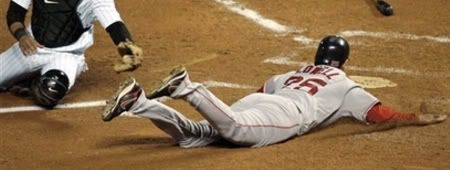
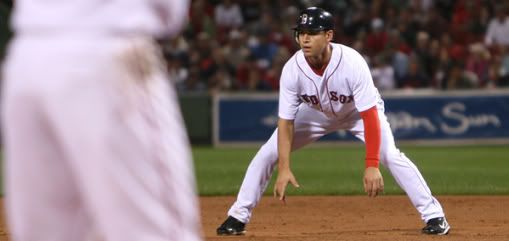
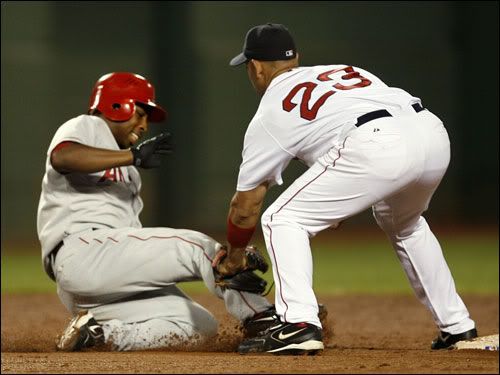
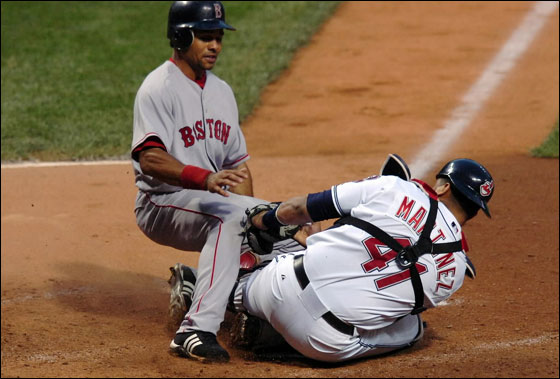
Sox On the Basepaths

Kelly O'Connor

In addition to providing projections for hitters and pitchers in 2008, the Bill James Handbook also rates the base running abilities of players. James provides every hitter in the majors a baserunning rating. These ratings are based on how factors such as bases taken, advances on outs, advancing extra bases on balls put in play, stolen bases, and outs made on the basepaths.

I'll provide two numbers. The first number is their baserunning rating. The second number is the percentage of the time that a player scored once they got on base (largely dependent on their spot in the order).

Jacoby Ellsbury: +13, 31%
Dustin Pedroia: +3, 34%

David Ortiz: +5, 30%
Manny Ramirez: -1, 29%

Mike Lowell: -11, 23%,
J.D. Drew: +6, 33%
Kevin Youkilis: +10, 28%

Jason Varitek: -23, 22%

Julio Lugo: +20, 29%


Alex Cora: 33%, +3

Coco Crisp: 35%, +37


Based on this information, you could make a case for Youkilis batting second in the order. He is a much better baserunner than Pedroia. Last year, Youkilis was rated the best baserunner on the team. For the second year in a row, Varitek was the team's worst baserunner. Overall in 2007, the Red Sox ranked as the 11th best baserunning team in the majors.

Saturday, January 5, 2008

Why We Wait

There are now officially 40 days left until pitchers and catchers report to Spring Training. We are deeply entrenched in winter. I don't know about you guys, but where I live it's been around 20-25 degrees out lately. At the moment, it feels as if the baseball season may never return.

So to keep up morale in these discouraging times, I've advised a plan. I'm going to try out a series of posts called "Why We Wait". And for each one, I'll list a reason why while the Red Sox season may seem far away, it will all be worth it come late March.

Today's reason - beating up the Yankees. No regular season win is quite so sweet as one that comes at the hands of our hated rivals. The first Red Sox/Yankees series of the 2007 series was especially sweet.

In the first game of the series, the Red Sox scored five runs in the 8th inning, to beat the Yankees by a run. Mariano Rivera blew his second straight save opportunity and Hideki Okajima notched his first major league save. Then, in the second game, the Red Sox won the series behind Josh Beckett. It was the final game of the series, however, that was most sweet.

On April 23rd, the Red Sox swept the series in dramatic fashion. They tied a major league record by hitting back-to-back-to-back-to-back home runs off of Yankees prospect Chase Wright. I can imagine Yankees fans thinking, "it's alright, no one was on" after the first home run. Then they probably thought, "alright, at least we're still up by a run" after the second home run. After the third, I'm sure they couldn't believe how they just lost their lead. And after the fourth I'm sure some of them had to turn off the TV for a little while.

Watch the video and relive the magic.

Tuesday, January 1, 2008

Top 5 Red Sox Prospects

1. Clay Buchholz, 23-Year-Old RHP

Clay Buchholz might just be the best pitching prospect in baseball, so he's a shoo-in for best Red Sox prospect. Buchholz to this point in his career has done everything right. Throughout the minors, he walked only 2.43 batters and struck out 11.23 hitters in every nine innings of work.

What makes Buchholz so special is the strength of his secondary pitches. The young pitcher's fastball sat in the low-90's for most of his career. At the end of 2007, however, Buchholz's fastball was sitting at 96 mph and it's his third best pitch. His arsenal of secondary pitches is what will likely make him an affective major league pitcher.

That arsenal includes two change ups, a curve ball, and a slider. His straight change up is his best out pitch. It sits at around 80 mph, about 15 mph off his fastball. Buchholz also possesses a strike out 12-6 curve ball which buckles the knees of hitters. For reference, see the last out of Buccholz's no-hitter, in which Nick Markakis sat helplessly with his bat on his shoulder.

2. Jacoby Ellsbury, 24-Year-Old CF

After being a World Series hero,
winning the Rookie of the Year Award doesn't sound all that exciting. But going into the season, Ellsbury is one of the most likely candidates. He's all a team could ask for in a leadoff hitter and center fielder. He's a left-handed slap hitter, who consistently puts the ball in play, gets on base, and advances on the bases once he gets on.

Ellsbury's also a defensive center fielder worthy of taking over for Coco Crisp. While he's not quite at Crisps's level, he's still one of the best defensive center fielders in the majors. His arm is only average, but it's pretty accurate. After Crisp and Damon, any arm at all is an improvement.

As of yet, Ellsbury doesn't have much power, but he is young. If he eventually develops 15-20 home run power, he has the potential to be one of the best center fielders in the majors. But as of now, his OBP and speed work perfectly at the top of the Red Sox batting order, even if he isn't going to hit home runs.

3. Jed Lowrie, 23-Year-Old SS

Lowrie possesses the plate discipline typical of so many Red Sox position players. Over his minor league career, he's gotten on base at a rate of .386. What makes Lowrie especially valuable though, is his developing power.

Lowrie slugged over .500 last year in significant time at both Double-A and Triple-A. That degree of power is incredible for a middle infielder. In fact, only 5 middle infielders slugged
.500 or batter last year at the major league level. Lowrie's power, combined with the fact that he's a switch hitter, makes him a valuable commodity. So the Red Sox might look to capitalize on his trade value while it is high.

Defensively, Lowrie is an average shortstop. He could be the Red Sox shortstop of the future, but the Red Sox would like him to improve on his throwing accuracy. If he is dealt to Minnesota, he would likely start the major league season as a second baseman where his throws would be shorter.


4. Justin Masterson, 22-Year-Old RHP

Like any sinkerball pitcher, Masterson's career success is difficult to predict. But Masterson isn't the typical sinkerballer. He allows very few hits or walks, and has struck out more than a hitter an inning at every stop but Lancaster, which is notorious for being hitter friendly. Masterson's upside is tremendous.

Similar to Derek Lowe, Masterson has shown great potential both as a starter and reliever. Masterson has the strange ability to vary the speed of his sinker from 84-94, and he gets an insane amount of ground balls. He has a good slider, and a work-in-progress changeup. If he
develops those pitchers further, he could make a quality top of the rotation starter.

Even at this point in Masterson's development however, he may be able to play a major league role similar to that of Julian Tavarez. Based on a team's needs, Masterson could be an average reliever or a back of the rotation starter.

5. Ryan Kalish, 19-Year-Old CF

At only 19 years of age, Kalish is already a four-tool-athlete, with the build to possibly develop power as well when he ages. Kalish was just drafted in 2006, and the organization worked with him quite a bit prior to his 2007 season. The work appears to have paid off. Looking at Kalish's Single-A line of .368/.471/.540, you'd think he played at Lancaster, but he in fact put those numbers up over 87 at bats in Single-A Lowell.


Kalish is a very exciting player for his age. He's got all the raw talent, including the ability to steal 18 bases last year in 23 games. If he develops the mental aspect of his game to match his physical abilities, he could have a bright future. He probably projects best as a right-fielder for the Red Sox, given his strong arm. If the Red Sox are patient with him and give him a full year at every level of the minors, he might be ready to take over for Drew in 2012, or perhaps even sooner.

Monday, October 1, 2007

Game One Preview - Lackey vs. Beckett

John Lackey vs. the Red Sox - This matchup particularly had Red Sox fans salivating over a Angels/Red Sox ALDS. Lackey will be facing some heavy demons when he takes the mound in Fenway Park. In 11 career starts against the Red Sox, Lackey's 1-6 with a 6.27 ERA and a WHIP of 1.92. He's struggled even more in Fenway Park where his ERA rises above 7 and his WHIP above 2.00.

Josh Beckett vs. the Angels - Josh Beckett has only four career starts against the Angels. In those starts, he has been dominant, going 2-0 with a 2.16 ERA and a WHIP of 1.08. While that's not much of a sample size, the Angels unfamiliarity with Beckett could work to his advantage.

Red Sox Hitter To Watch:
J.D. Drew -
After a disappointing first half, Drew stepped it up a bit in the second half. His hottest month of the season was September in which he hit .342/.454/.618. Drew hits much better at home (.834 OPS vs. .763 OPS) and is the Red Sox hitter with the most success against Lackey. Drew's 4-5 against Lackey with a triple and an RBI.

Angels Hitter To Watch:
Garret Anderson - Anderson is another player who has had a good second half. Since the All-Star break he's hit .305/.361/.530. Anderson has former success at Fenway Park, and limited success against Josh Beckett. And other than Vlad himself, Anderson has the highest SLG on the team. His forte is driving in runs. Anderson is not the guy you want at the plate in a big game situation.

Miscellanious Game Notes - Baserunners have had a success rate of 70% against Beckett this season. That isn't quite as bad as it looks, but it's not going to shut down a running game. Baserunners have an even better success rate against Lackey this year but I don't expect the Red Sox to run a lot given their former success against him.

One thing to watch is just how aggressive the Angels are on the basepaths. Everyone in the world knows the Angels like to run, so the Red Sox may attempt some "novelty" plays on defense. I say novelty in quotation marks because nothing's a novelty if it gets you outs, especially in the playoffs.

The intracacies of Fenway Park may also work to the advantage of the Red Sox. The Angels aren't familiar with the park, as they typically only play in it for 3 games a year. There are times in Fenway Park when you have to be conservative on the bases. Grounders down the left field line that would be doubles anywhere else, often bounce off the stands and come back into the infield. Balls hit off the Green Monster are often just long singles but the Angels could get into trouble trying to stretch them into doubles.


There's a good chance the starters may not decide this game. Angels set up man Scot Shields has been horrid against the Red Sox in his career. In 21 games, Shields has an ERA of 7.71 and a WHIP of 1.75. He's also allowed 6 home runs.

If Beckett does not last 7 innings, there's a good chance the Red Sox will bring in Eric Gagne for the 7th. Gagne hasn't allowed a run in his last five appearances but he's blown up in important spots with the Red Sox. The Angels could easily turn just a walk into a double with a stolen base and I wouldn't trust Gagne to prevent that runner from scoring.