Showing posts with label Josh Beckett. Show all posts

Thursday, January 10, 2008

John Farrell An Unsung Hero of 2007


(Brita Meng Outzen/MLB.com)

In 2006, Red Sox pitching was utterly embarrassing. Their staff ranked fifth to last in ERA and was below major league average in quality starts, batting average against, total walks, complete games and shut outs. Although the Red Sox finished third in the AL East, their pitching staff was more comparable to those of basement dwelling teams.

In 2007, the Red Sox saw dramatic improvement in their pitching staff. Among other American League teams, the Red Sox staff's ERA, WHIP and BAA went from 10th or worse to first. The staff's overall walk total decreased by 27 and their strikeout total increased by 79. Newcomers Diasuke Matsuzaka and Hideki Okajima helped, but for the most part the Red Sox returned the same pitching staff from 2006. Of the 13 pitchers who made significant contributions in 2007 (at least 35 innings), all but two of them were holdovers from 2006.

So what was the largest difference to the Red Sox pitching staff in 2007? I'd like to make the case for new Red Sox pitching coach John Farrell. First of all, I'll provide a quick background on Farrell. Outside of college baseball he had never coached before 2007. He did serve as the Director of Player development for the Cleveland Indians starting in late 2001. He helped the organization to have 2003's top rated farm system according to Baseball America.

He left the Indians organization to become the Red Sox pitching coach last year, and already he's made some serious waves. In Spring Training, Farrell worked with Josh Beckett to help him standardize his delivery. Beckett posted his lowest BB/9 since he was drafted and had a career year at the major league level.

Farrell also worked with new pitcher Hideki Okajima. In the humidity of Florida Spring Training, Okajima had trouble with his changeup. So Farrell helped him to devliver a new grip on his changeup, which would create more movement. The result was the creation of Okajima's split-change nicknamed the "Okie Doke". And against major leaguers in 2007, Okajima had a lower WHIP than he ever had in the 11 years that he faced Japanese hitters.

Under the tutelage of Farrell, young pitchers Jon Lester and Manny Delcarmen also saw positive improvements in their development. I'm not sure if Jonathan Papelbon really needed all that much tutelage, but in 2007 he lead the majors in K/9 innings pitched.

In 2008, Farrell will look to continue the development of young Red Sox pitchers. Farrell has fallen in love with Jon Lester, and seems determined to make the young lefty his next project. But I'm sure Farrell will also work extensively with Daisuke Matsuzaka and Clay Buchholz. And God forbid if Farrell works on Beckett any more, that would just be unfair.

Sunday, January 6, 2008

The Fenway Park Effect - Introduction

Ever wonder how Dustin Pedroia managed to hit .317 as a rookie? Perhaps you're left scratching your head over how Drew's home run total was cut in half in 2007? Maybe you want to know if Fenway Park really does cause errors, as Renteria claimed in 2005? Well thanks to the Bill James Handbook, we have some answers.

Now park effect doesn't explain or account for everything. Obviously, Pedroia has to be able to hit to get a .317 batting average, regardless of the park he plays in. Park effects mostly help us to understand some trends in pitching and hitting performance. It's especially useful when trying to understand how players' performances may be affected by switching teams. At the same time, it works to create more answers. Such as how is it that the Red Sox lead the AL in ERA, while also pitching in the league's most hitting friendly park?

First of all, I'll talk about Fenway Park's effect on producing runs. A park rating of 100 is neutral, regardless of the category. In the category of producing runs, Fenway Park received a rating of 118 in 2007. That rating lead the majors, but what exactly does it mean? A rating of 118 means that it was 18% easier to score a run in Fenway Park, than it was to score a run in a neutral run scoring park.

So what does such a rating tell us? The first conclusion I'd come to is that the Red Sox offense is probably a bit overrated. If it is 18% easier to score a run in Fenway Park, than it is a neutral run scoring park, Red Sox offensive numbers are probably inflated. This could help to explain how the Red Sox have ranked among baseball's top five offenses in five out of the last six years.

But that's only half the story. If it's so much easier to score runs in Fenway Park, then what's that mean for the Red Sox pitchers? No doubt, if it's easier to score runs in Fenway Park, it's also much harder to prevent runs. But how much more difficult is it for Red Sox pitchers to prevent runs?

In a perfect world, the average American League park would be neutral. And since the Red Sox play half their games at Fenway Park, it would be 9% harder for Red Sox pitchers to prevent runs, assuming they make half their starts at home and half on the road. And in this case, Beckett's already sterling 2007 ERA of 3.27 would look more like 2.97 had Fenway Park been a hitter neutral park.

But we don't live in a perfect world. In reality, Beckett pitched almost 20 more innings at home than he did on the road last year. And the average American League park wasn't neutral. The average American League park last year was somewhere between Comerica Park and Kauffman Stadium, and was around 5% easier to score a run in than a neutral park.

So I'll account for the fact that Beckett pitched 54.8% of his innings at home, and the fact that the average AL park had a run scoring rating of 105 or +5%. Now, if Beckett pitched in a hitter neutral park, his ERA would have looked more like 3.11. So was he robbed of a Cy Young Award?

Not so fast, the second most run scoring friendly park in the American League was Jacob's Field, where C.C. Sabathia pitched his innings when he was at home. If you adjust both of their home innings to the neutral American League park, their numbers would look more similar, but only slightly.

And my calculations above ignored the fact that Beckett pitched many of his starts in NL Parks, where the average run scoring factor wasn't 105. And the NL parks which Beckett pitched in were different than the NL parks that Sabathia pitched in. So when it comes down to it, park effect is so complicated that it's wise to just ignore their effects on competitions like the Cy Young Award.

Besides, Rays fans would have more a case for Delmon Young being robbed of a Rookie of the Year Award. Fenway Park's effect on right-handed batting average was almost as great as its effect on run scoring. And unlike the Cy Young Award where both competitors played in rather similar parks, Delmon Young's Tropicana Field actually was one of the least friendly parks for right-handed batting average. It was also a below neutral park for run scoring.

More than ERA, park factors affect the total runs that teams score. This is because ERA is a ratio stat, and the total effects of it are divided by 9. The same can be said about other ratio stats like H/9, BB/9 and K/9. Raw totals like Runs Scored are more skewed by park effect. If the Red Sox played in a neutral run scoring park in 2007, their runs scored total would look more like 802. This means that their runs scored total might not have ranked among the top five in the American League.

Again, this is difficult to calculate because eight out of the top ten run scoring teams in the American League last year played in parks which were friendly to scoring runs. The only two teams in the top 10 who were hurt by their park factor were the Rays and the Blue Jays.

The effect of Fenway Park on offensive production is so complicated, that I've broken it up into multiple parts. This article is only the beginning. Later, I will look at how Fenway Park affects average, home run totals, and errors. Many of these answers are sure to surprise you.

I know some of this information can be complicated, and not all of you have the Bill James Handbook handy as you read this. So if you have any questions, or need anything clarified, feel free to ask.

Saturday, January 5, 2008

2008 Red Sox Pitching Projections - Starters

(Brian Snyder/Reuters)

So I just got my hands on a copy of the Bill James Handbook. It's become an annual tradition for me to view the information in it. Others might find it boring, but for me it provides some interesting food for thought when I'm in desperate need for baseball. I'm going to be discussing a lot of information in the book over the next few weeks. To begin the discussion I thought I'd look at the projections for the Red Sox starting pitchers. Here are the projections, coupled with my thoughts.

Josh Beckett - 3.50 ERA, 1.22 WHIP (203 IP, 184 H, 64 BB, 187 SO)

I was a little surprised to see such a high ERA projection, even though 2007 was a career year for Beckett. Since his rookie season, Beckett's posted an ERA on the lower side of 3.50 most of the time. Other than Beckett's atypical 2006 season, Beckett's BB/9 IP has gone down every year, yet the projection expects it to go back up in 2008.

I can understand why the projection is so high, as projections must give weight to Beckett's 2006 season. But most indications point to 2006 being an off year and 2007 being an indicator of improving ability at the major league level as he enters the prime ages of most pitchers' careers.

Daisuke Matsuzaka - 3.54 ERA, 1.23 WHIP (
193 IP, 173 H, 64 BB, 184 SO)

I was surprised by these numbers too, but this time because of how low they were. But I can understand why the projection would like Daisuke so much. These numbers are similar to the ones he posted before he wore down late in the season. Matsuzaka had an ERA of 3.84 and a WHIP of 1.24 in the first half of 2007. Daisuke's ERA was as low as 3.59 on August 10th. You also have to consider that 2007 was Matsuzaka's rookie season.

Curt Schilling - 3.54 ERA, 1.16 WHIP (160 IP, 161 H, 25 BB, 150 SO)

I was quite surprised by this projection as well. Schilling hasn't posted a year like this since 2004, and he's not getting any younger. It's not that Schilling didn't have a very good year in 2007 (3.87 ERA, 1.25 WHIP). But why is his 2008 expected to be such an improvement? His projection seems to think there will be drastic drops in his hits rate and a drastic improvement in his strike out rate.


Tim Wakefield -
4.03 ERA, 1.31 WHIP (181 IP, 174 H, 63 BB, 123 SO)

Wakefield is up and down year to year but it's been a while since he's put up some numbers like these. Either the Bill James Handbook thinks Wakefield the fountain of youth, or they just assume every pitcher over 40 uses performance enhancers.

Jon Lester - 4.42 ERA, 1.55 WHIP (175 IP, 183 H, 89 BB, 149 SO)

It's easy to get excited about Lester given his raw stuff, but this is probably a fair projection for 2008. The numbers aren't great but they're about league average for a starter.

Clay Buchholz

Although Buchholz figures to play a large role in the Red Sox rotation, the Bill James Handbook could not project his statistics based on such a small major league sample size.

Why We Wait

There are now officially 40 days left until pitchers and catchers report to Spring Training. We are deeply entrenched in winter. I don't know about you guys, but where I live it's been around 20-25 degrees out lately. At the moment, it feels as if the baseball season may never return.

So to keep up morale in these discouraging times, I've advised a plan. I'm going to try out a series of posts called "Why We Wait". And for each one, I'll list a reason why while the Red Sox season may seem far away, it will all be worth it come late March.

Today's reason - beating up the Yankees. No regular season win is quite so sweet as one that comes at the hands of our hated rivals. The first Red Sox/Yankees series of the 2007 series was especially sweet.

In the first game of the series, the Red Sox scored five runs in the 8th inning, to beat the Yankees by a run. Mariano Rivera blew his second straight save opportunity and Hideki Okajima notched his first major league save. Then, in the second game, the Red Sox won the series behind Josh Beckett. It was the final game of the series, however, that was most sweet.

On April 23rd, the Red Sox swept the series in dramatic fashion. They tied a major league record by hitting back-to-back-to-back-to-back home runs off of Yankees prospect Chase Wright. I can imagine Yankees fans thinking, "it's alright, no one was on" after the first home run. Then they probably thought, "alright, at least we're still up by a run" after the second home run. After the third, I'm sure they couldn't believe how they just lost their lead. And after the fourth I'm sure some of them had to turn off the TV for a little while.

Watch the video and relive the magic.

Monday, October 1, 2007

Game One Preview - Lackey vs. Beckett

John Lackey vs. the Red Sox - This matchup particularly had Red Sox fans salivating over a Angels/Red Sox ALDS. Lackey will be facing some heavy demons when he takes the mound in Fenway Park. In 11 career starts against the Red Sox, Lackey's 1-6 with a 6.27 ERA and a WHIP of 1.92. He's struggled even more in Fenway Park where his ERA rises above 7 and his WHIP above 2.00.

Josh Beckett vs. the Angels - Josh Beckett has only four career starts against the Angels. In those starts, he has been dominant, going 2-0 with a 2.16 ERA and a WHIP of 1.08. While that's not much of a sample size, the Angels unfamiliarity with Beckett could work to his advantage.

Red Sox Hitter To Watch:
J.D. Drew -
After a disappointing first half, Drew stepped it up a bit in the second half. His hottest month of the season was September in which he hit .342/.454/.618. Drew hits much better at home (.834 OPS vs. .763 OPS) and is the Red Sox hitter with the most success against Lackey. Drew's 4-5 against Lackey with a triple and an RBI.

Angels Hitter To Watch:
Garret Anderson - Anderson is another player who has had a good second half. Since the All-Star break he's hit .305/.361/.530. Anderson has former success at Fenway Park, and limited success against Josh Beckett. And other than Vlad himself, Anderson has the highest SLG on the team. His forte is driving in runs. Anderson is not the guy you want at the plate in a big game situation.

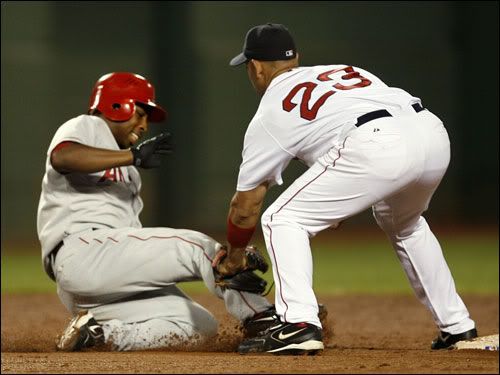
Miscellanious Game Notes - Baserunners have had a success rate of 70% against Beckett this season. That isn't quite as bad as it looks, but it's not going to shut down a running game. Baserunners have an even better success rate against Lackey this year but I don't expect the Red Sox to run a lot given their former success against him.

One thing to watch is just how aggressive the Angels are on the basepaths. Everyone in the world knows the Angels like to run, so the Red Sox may attempt some "novelty" plays on defense. I say novelty in quotation marks because nothing's a novelty if it gets you outs, especially in the playoffs.

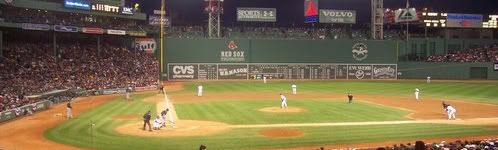
The intracacies of Fenway Park may also work to the advantage of the Red Sox. The Angels aren't familiar with the park, as they typically only play in it for 3 games a year. There are times in Fenway Park when you have to be conservative on the bases. Grounders down the left field line that would be doubles anywhere else, often bounce off the stands and come back into the infield. Balls hit off the Green Monster are often just long singles but the Angels could get into trouble trying to stretch them into doubles.


There's a good chance the starters may not decide this game. Angels set up man Scot Shields has been horrid against the Red Sox in his career. In 21 games, Shields has an ERA of 7.71 and a WHIP of 1.75. He's also allowed 6 home runs.

If Beckett does not last 7 innings, there's a good chance the Red Sox will bring in Eric Gagne for the 7th. Gagne hasn't allowed a run in his last five appearances but he's blown up in important spots with the Red Sox. The Angels could easily turn just a walk into a double with a stolen base and I wouldn't trust Gagne to prevent that runner from scoring.